01
A move documented in Inukai’s own essays
Inukai’s own writing documents her residence at Ashiya Grand Heights. Her spring 1967 essay in Kurashi no Techo describes the move from Tokyo to Ashiya. The summer installment includes a photograph and a caption identifying Grand Heights as her home.
Slide 52 of the supplied research records that Hana-bana to hoshi-boshi to was written at Ashiya Grand Heights. This finding is presented with that provenance. A family memoir composed within a new postwar apartment building connects architectural history with literary work.
02
Two houses connected through Arata Endo
Endo designed Tsuyoshi Inukai’s house through Jiro Hoshijima’s introduction, completing it in 1922. Yodoko’s official history draws on Michiko’s recollections of its rooms and verandas, making her writing a source for residential architectural history.
At the Yamamura villa in Ashiya, Endo and Makoto Minami developed Wright’s design. Official research also reports Tsuyoshi’s overnight visit on 13 December 1925, based on the contemporary Kobe newspaper. The grandfather’s house, his visit to Ashiya and the granddaughter’s later apartment life form a connected local history.
03
Momoko Ishii and the Japanese encounter with Pooh
The Inukai family also connects with Japanese children’s literature. The International Library of Children’s Literature lecture records Ishii encountering The House at Pooh Corner at Ken Inukai’s home at Christmas 1933 and translating it aloud for Michiko and Yasuhiko. Reading it later to her ill friend Fumiko Kosato also mattered. Her first translated book, Kuma no Puu-san, appeared in 1940.
Institutional sources and a publisher’s excerpt of Momoko Ishii’s own writing describe her encounter with an English book at the Inukai home and her experience of translating it aloud. Saitama City Library also records her work organizing the family’s books. These exchanges illuminate the Japanese reception of Winnie-the-Pooh.
04
Riu Murayama: residence and local cultural life
Slide 53 of the supplied research identifies Riu Murayama, known for her Genji talks and writing, as another Ashiya Grand Heights resident. The residence finding is attributed to that research, while municipal records independently document her public cultural work.
Ashiya’s 1978 newsletter reports her civic culture award and donation of Genji recordings for education. Its 1989 newsletter advertises a lecture series. Housing’s cultural significance grows clearer when residence is connected with writing, spoken classics and local learning, beyond a list of famous names.
05
Photographs of Michiko Inukai’s new home in 1967
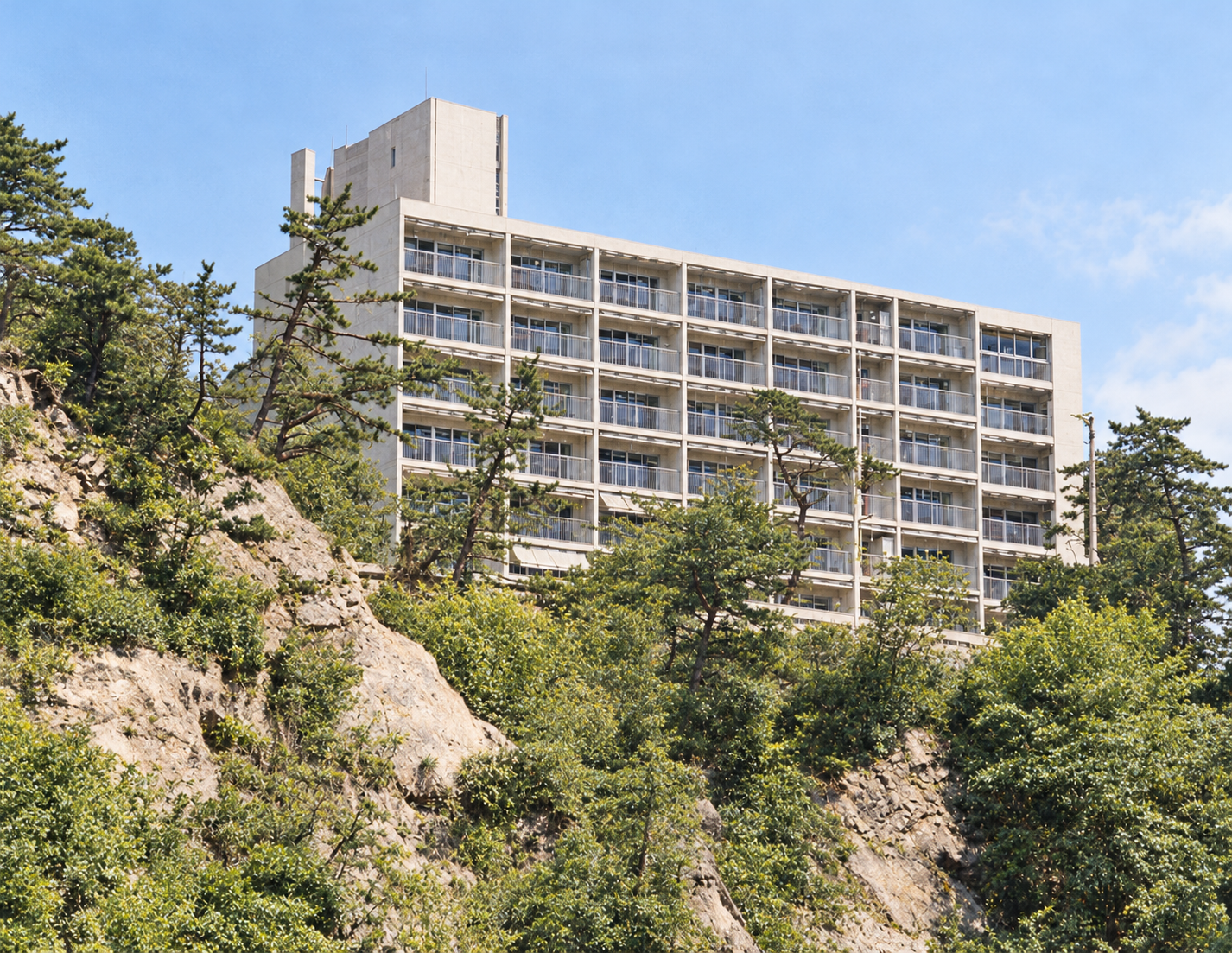
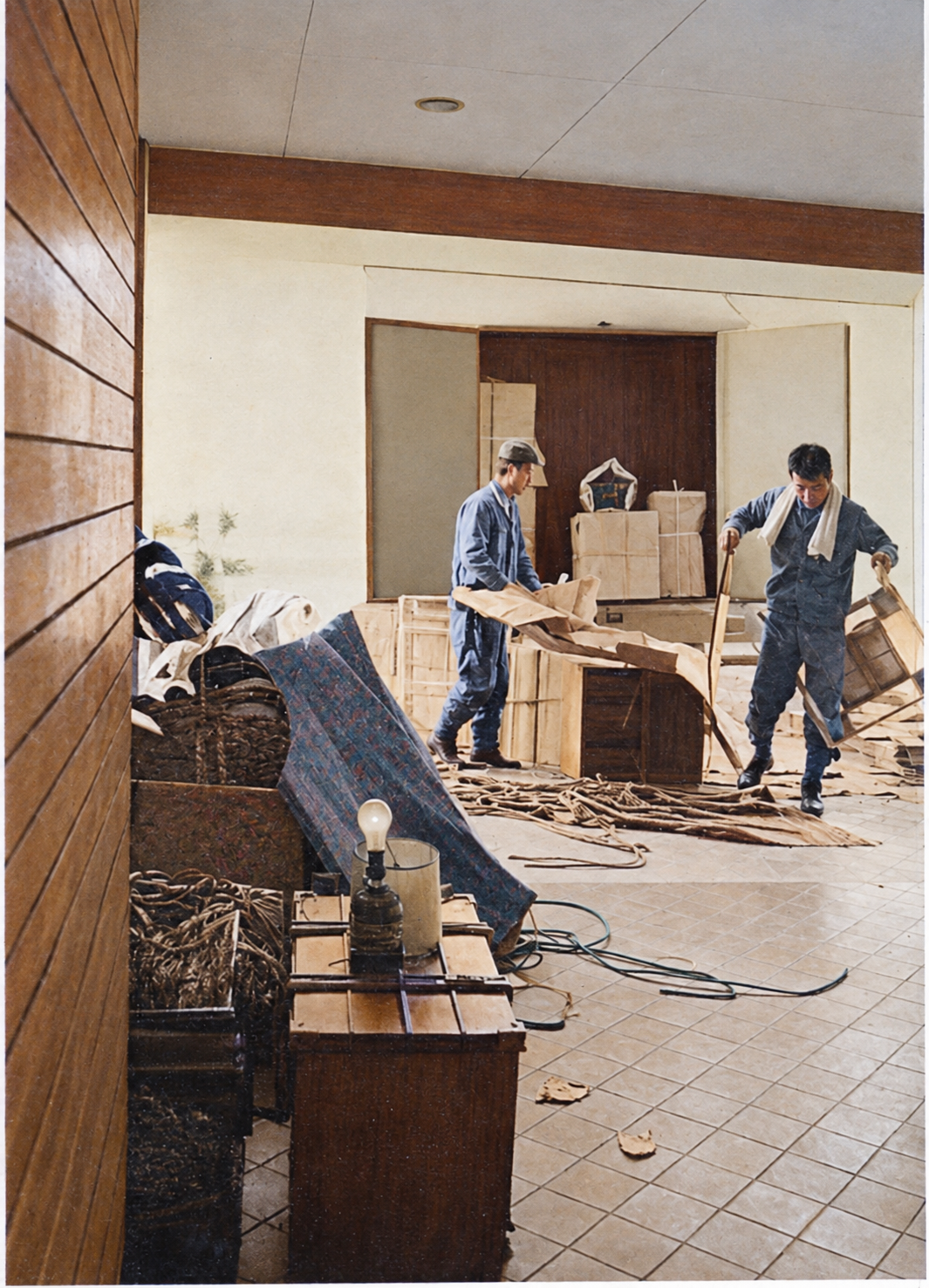
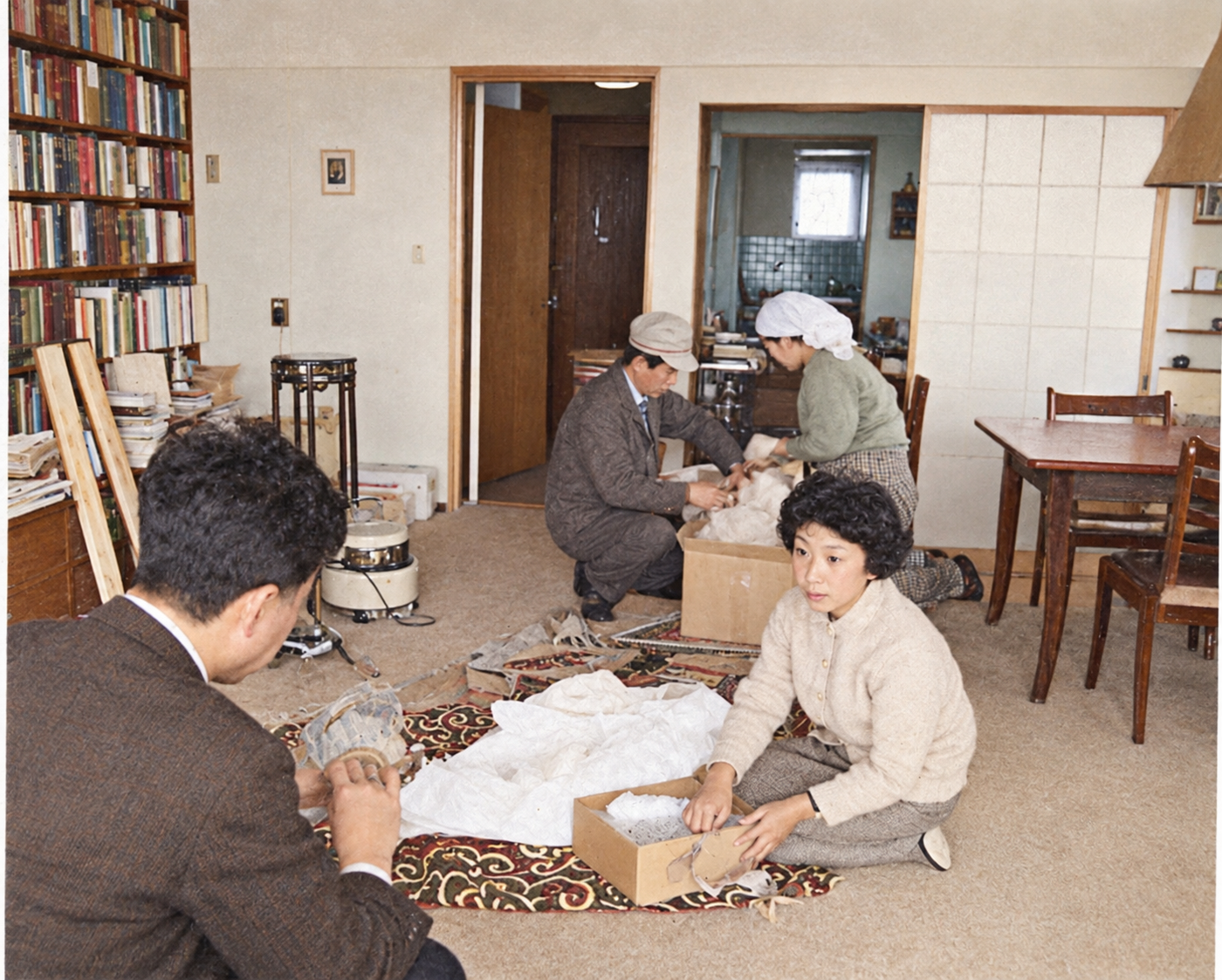
Michiko Inukai’s summer 1967 essay includes photographs of the recently completed Ashiya Grand Heights and the work of moving in. The white façade rising above rock and planting, unpacked belongings, bookshelves and windows connect the architecture with everyday habitation.
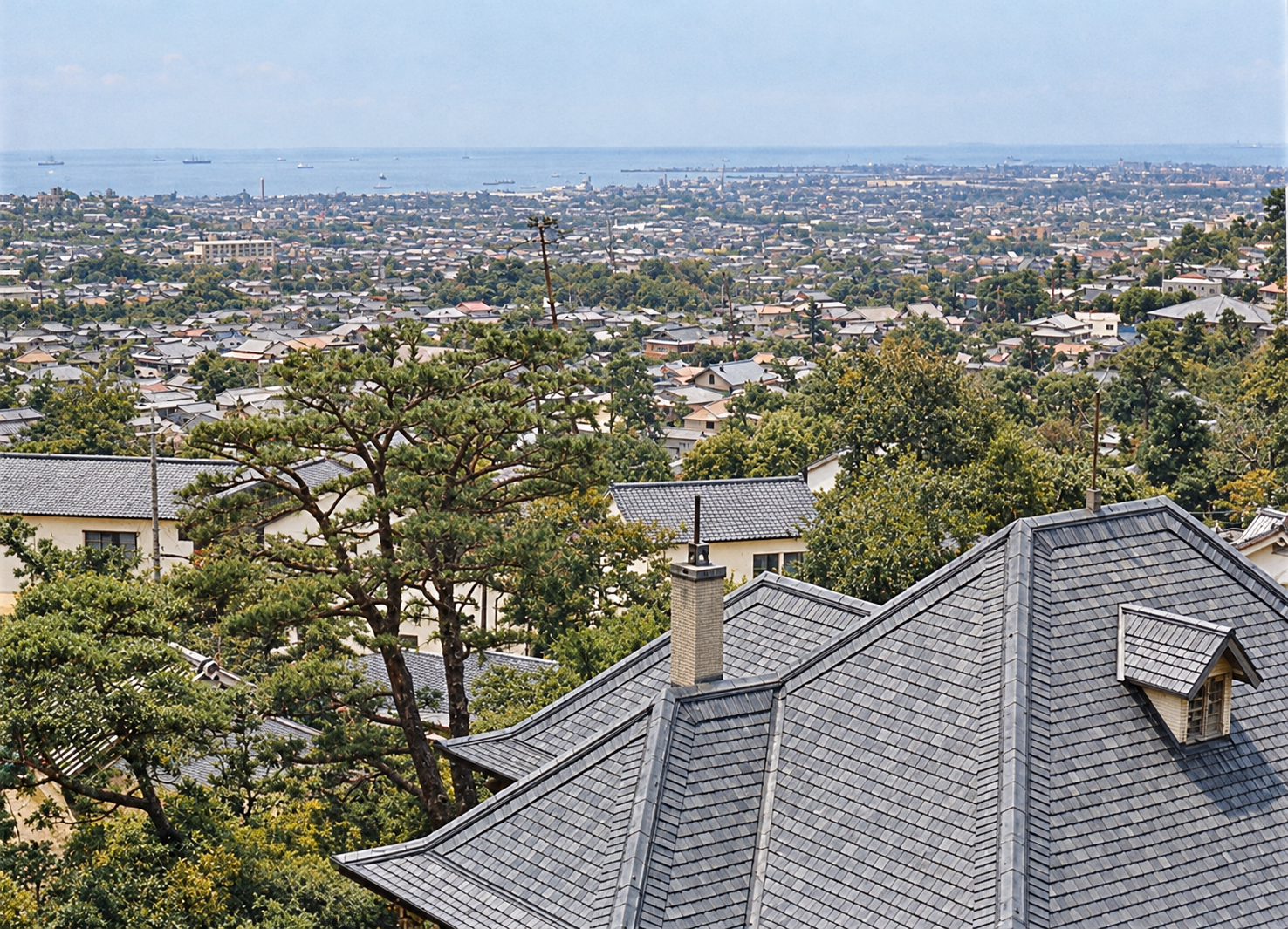
A photograph accompanying the autumn essay opens towards Ashiya and Osaka Bay. The view becomes part of a writer’s encounter with a new place. These records extend the regional story linking the Inukai family, Arata Endo and the former Yamamura residence.
- research-private 芦屋グランドハイツの系譜と価値・補強版/耐震追補(提供研究、2025年11月16日)
提供調査資料 · An edited thematic reading of the supplied 54-slide deck and 82-page expanded supplement, covering people, technology, place, housing, equipment, culture, recovery and preservation proposals. Corrections are recorded in the research notebook; private details are excluded.
06
From relocation to a critique of housing: seven essays
Seven essays published in Kurashi no Techo in 1967–1968 move from Inukai’s relocation to choices of residence, urban observation, regional language, practical layouts, mountains and sky. They are contemporary records of Ashiya Grand Heights as a place where a writer lived, thought and worked.
The summer installment develops from the surprise that greeted Inukai’s voluntary move from Tokyo into a discussion of freedom to choose where to live. On its final page she describes a home as a base camp: a place suited to one’s work and daily life, whose location can change as circumstances change. Read as the testimony of someone beginning life in Ashiya, it presents this apartment building as a base for further activity. The resident’s own conception of home adds a human perspective to its architectural form.
The sixth instalment, Apartments, Mansions, Villas and Maisons, includes plans of a Paris apartment and two homes in Cambridge. The Paris plan distinguishes the main entrance from a service entrance connected to the kitchen and rear garden. Inukai relates shopping, deliveries and visitors to domestic circulation, and considers entrance controls and intercoms through lived experience. This offers a way to read collective housing through the arrangement of rooms and the movements that connect them.
07
Reading books and looking at the town: encountering architectural ideas
She takes books on urban planning and Le Corbusier from her shelves, reads them and looks at the town again. Architectural reading becomes a way to consider its scale, roofs, greenery and waterfront. For Ashiya Grand Heights, this adds a resident’s reception of architectural ideas to the history of the place.
A photograph captioned The mountain over there seen from the Ashiya River brings together the river, a bridge, riverside buildings and the mountains beyond. Her essay extends to the use of the hills, the care of trees and ways of sustaining both nature and everyday life. It invites a reading of the view from a residential window or balcony as part of a shared regional environment and culture.
In Sky, the ninth instalment, Michiko Inukai relates the sky seen from her windows and veranda to light and colour experienced on her travels. Her description of home includes the sea, distant mountains, aircraft lights, windows in the kitchen and bathroom, and views in every direction. Sitting by an east-facing window for sunrise and returning to the windows in the evening make looking at the sky part of her daily rhythm.
Sources for this essay
- research-private 芦屋グランドハイツの系譜と価値・補強版/耐震追補(提供研究、2025年11月16日)
提供調査資料 · An edited thematic reading of the supplied 54-slide deck and 82-page expanded supplement, covering people, technology, place, housing, equipment, culture, recovery and preservation proposals. Corrections are recorded in the research notebook; private details are excluded.
- primary-private トラック西へ行く(連載第1回)
犬養道子/暮しの手帖社 · Kurashi no Techo, first series, no. 89 (1967-05), pp. 140–149. All 10 supplied essay pages, including figures, visually read. Issue/month checked against the publisher’s cover chronology; title/issue corroborated by a published contents listing.
- primary-private 落人騒動(連載第2回)
犬養道子/暮しの手帖社 · Kurashi no Techo, first series, no. 90 (1967-07), pp. 164–171. All 8 supplied essay pages, including figures, visually read. Issue/month checked against the publisher’s cover chronology; title/issue corroborated by a published contents listing.
- primary No.1 建築のはじまり ↗
井上祐一 · 公式公開本文を確認。犬養邸の設計・竣工と犬養道子の回想への参照。
- primary No.2 震災直後の建築 ↗
井上祐一 · Read the official public commentary referring to the ridge inscription, newspaper accounts and conservation report. The reading scope is that commentary.
- primary 芦屋市民文化賞 第12回受賞者 — PDF ↗
芦屋市 · Read the relevant extracted passages of the public PDF on Riu Murayama’s name, cultural award and donation of Genji recordings for Japanese-language education. Its scope is her public cultural activities.
- primary 古典文学連続セミナー 村山リウがかたる『源氏の世界』 ↗
芦屋市 · 市の目次と公開PDF抽出本文で講座の告知を確認。
- primary 石井桃子 — PDF ↗
小寺啓章 · Read the relevant passages of the public lecture, including its references and excerpts from Ishii’s Poo to watashi and the afterword to the 1940 translation. Volume references follow their individual catalogues.
- primary 『プーと私』解説「深く関わっていける」資質 ↗
梨木香歩(解説)、石井桃子(引用対象) · Read the publisher’s public commentary and its excerpt from Momoko Ishii’s Poo to watashi. The reading scope is the commentary and quoted passage.
- primary 児童文学者コーナー 石井桃子 ↗
国立国会図書館国際子ども図書館 · 公式展示本文を確認。『熊のプーさん』(岩波書店、1940年)が最初の訳書であることを明記。
- primary-private 国際文化住宅都市芦屋(連載第3回)
犬養道子/暮しの手帖社 · Kurashi no Techo, first series, no. 91 (1967-09), pp. 174–181. All 8 supplied essay pages, including figures, visually read. Issue/month checked against the publisher’s cover chronology; title/issue corroborated by a published contents listing.
- primary-private 考えときまっさ(連載第4回)
犬養道子/暮しの手帖社 · Kurashi no Techo, first series, no. 92 (1967-12), pp. 192–197. All 6 supplied essay pages, including figures, visually read. Issue/month checked against the publisher’s cover chronology; title/issue corroborated by a published contents listing.
- primary-private アパート・マンション ビラ・メゾン(連載第6回)
犬養道子/暮しの手帖社 · Kurashi no Techo, first series, no. 94 (1968-04), pp. 192–197. All 6 supplied essay pages, including figures, visually read. Issue/month checked against the publisher’s cover chronology; title/issue corroborated by a published contents listing.
- primary-private むこの山(連載第8回)
犬養道子/暮しの手帖社 · Kurashi no Techo, first series, no. 97 (1968-10), pp. 190–197. All 8 supplied essay pages, including figures, visually read. Issue/month checked against the publisher’s cover chronology; title/issue corroborated by a published contents listing.
- primary-private 空(連載第9回)
犬養道子/暮しの手帖社 · Kurashi no Techo, first series, no. 98 (1968-12), pp. 196–201. All 6 supplied essay pages, including figures, visually read. Issue/month checked against the publisher’s cover chronology; title/issue corroborated by a published contents listing.
- primary 花森安治 特設サイト:第1世紀の表紙年表 ↗
暮しの手帖社 · First-series cover chronology, entries 89–100. The nine supplied essays correspond to nos. 89, 90, 91, 92, 94, 97, 98, 99 and 100.